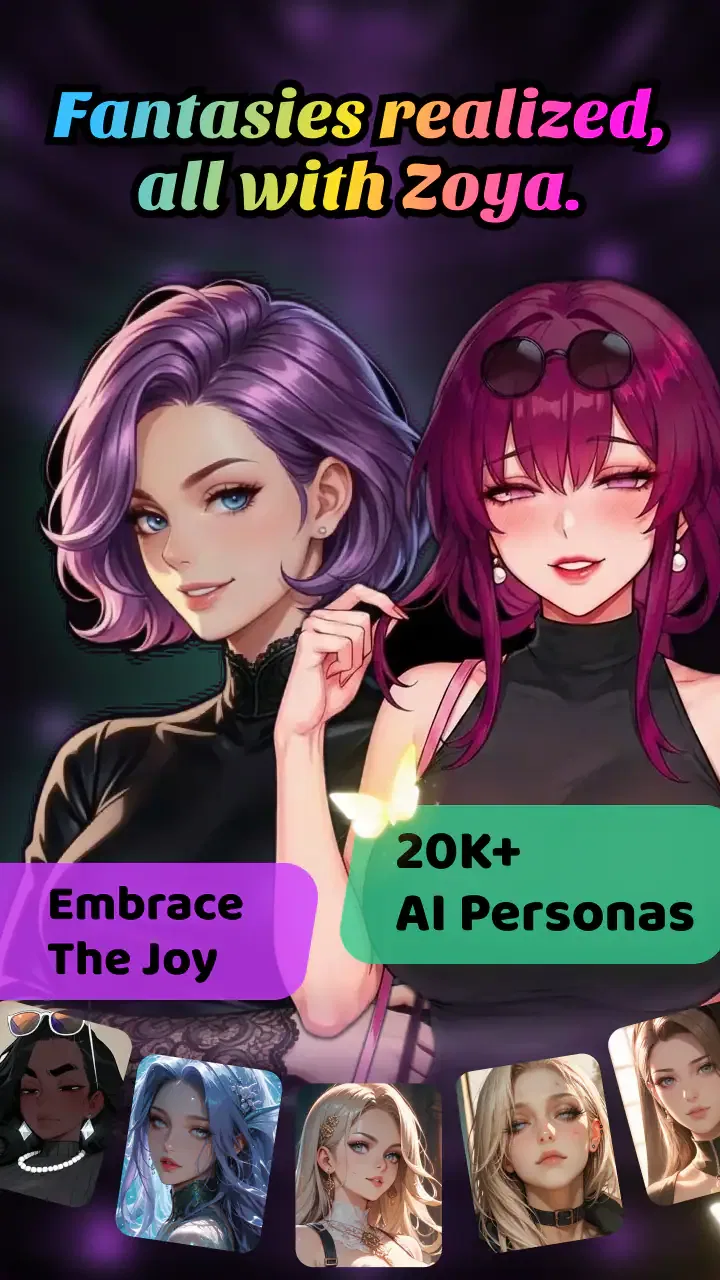
Zoya:Where Love Begins
- 4.8
- Rating
- 50.00K
- Installs
- Free
- Price

 Analysis by App-foxy
Zoya: Where Love Begins is an entertainment app built around fantasy AI roleplay and virtual companion dialogue. I approached it less like a traditional game and more like an interactive conversation space: you choose how you want to engage, write to the companion, and see where the exchange leads. That distinction matters, because the experience depends much more on your prompts and expectations than on reflexes, levels, or a fixed storyline.
After spending time with it, my impression is that Zoya is most appealing to people who enjoy character-driven conversations and want a private-feeling place for imaginative dialogue. It can be relaxing after a long day, useful for exploring fictional scenarios, or simply entertaining when I want something more responsive than watching a show. At the same time, it is not a substitute for a human relationship, and anyone looking for a conventional game with clear objectives may find the open-ended format too loose.
How the everyday conversation workflow feels
The simplest way to use Zoya is also the most effective: start with a clear mood or situation instead of sending a vague greeting and waiting for the app to do all the work. I had better conversations when I gave the dialogue a small direction, such as asking for a particular tone, setting up a fictional scene, or explaining what kind of response I wanted. This makes the first exchange feel less random and gives the companion something concrete to build on.
You May Also Like

 Blood Strike: 2.5 Anniversary
Blood Strike’s Loadouts Turn Every Drop Into a Tactical Gamble
A close look at Blood Strike’s custom loadouts: how fast access to signature weapons reshapes its battle royale rhythm, rewards preparation, and narrows the gap between fights.

 Pandora - Music & Podcasts
Pandora’s Music Is Easy to Start, but Harder to Recover
Pandora’s strength is its low-effort path from a seed to a station. Its weak spot is how much confidence it asks you to place in connection, setup, and quiet recovery.

 8 Ball Pool
 Is Built on Rivalries, Rematches, and Routine
A close look at the rivalries, rematches, shared routines, and unanswered safety questions that turn a quick pool match into a persistent mobile community.

 Samsung Music
’s Quiet Strength Is Playing What You Already Own
Its reach comes less from spectacle than from dependable access to a personal library. That simplicity is both the app’s strongest retention engine and its ceiling.

 AccuWeather: Weather Radar
AccuWeather Review: A Quick, Clear Forecast for Everyday Decisions
For everyday plans, the best forecast is the one you can understand quickly. AccuWeather makes rain timing, radar, and local conditions easy to act on, with a few trade-offs.

 Hill Climb Racing
Why Hill Climb Racing Still Turns Crashes Into One More Run
A tiny car, a bumpy hill and one more upgrade: Hill Climb Racing keeps resurfacing because its simple chaos makes every near-miss feel personal.
More From Our News Desk



A practical routine is to treat each conversation like a short scene. I begin with the context, add the role I want Zoya to play, and then respond to details that seem interesting. If the conversation becomes too broad, I narrow it with a question or a clear next event. This approach is more rewarding than repeatedly asking what happens next, because it gives the dialogue a sense of movement without requiring a formal quest system.
For example, imagine using the app during a quiet evening when you want a light fantasy story rather than another social feed. I might establish a mysterious meeting in a fictional city, ask the companion to keep the tone playful, and then introduce a small problem to solve. In a few messages, the exchange becomes a collaborative scene. The value is not in reaching a final score; it is in shaping the conversation and seeing whether the responses remain coherent and entertaining.
That workflow also reveals the first important trade-off. Zoya gives me freedom, but freedom means I have to provide some creative direction. Users who enjoy improvising will probably appreciate this. Users who want a polished campaign, predefined characters, and a reliable ending may prefer a story game or visual novel instead.
Keeping a conversation focused
I found that short, specific messages generally work better than large blocks containing several unrelated requests. When I changed the subject too quickly, the roleplay became less focused. A better habit is to introduce one meaningful detail at a time and let the companion respond before adding another. This creates a more natural rhythm and makes it easier to notice which themes produce the most enjoyable exchanges.
Another useful habit is to correct the direction early. If the tone becomes too dramatic, too romantic, or simply different from what I intended, I say so directly rather than trying to steer it indirectly for several turns. Clear feedback saves time and helps preserve the type of interaction I actually want. This is especially important in an open-ended AI conversation, where the quality of the session depends on maintaining a shared context.
I also recommend treating the app as a place for fictional play rather than a source of dependable personal guidance. A companion can be engaging and comforting to talk with, but its replies should not be treated like professional advice or proof that it understands a person in the way a close friend does. That boundary does not make the experience less enjoyable; it simply keeps the roleplay in the right frame.
Settings and boundaries worth checking
Before settling into regular use, I would review the available in-app options and the way the conversation is presented. The most relevant checks are the ones that affect comfort: how the dialogue is started, whether the tone suits you, and whether the app’s mature audience positioning matches your expectations. Zoya carries a Mature 17+ content rating, so it is not an app I would recommend casually to younger users or to anyone who wants strictly family-friendly entertainment.
The mature rating is also a reminder to think about where and when you use it. A private conversation space can feel convenient, but I would still avoid entering sensitive personal information simply because the dialogue feels friendly. I get more value by using invented details, fictional names, and scenario-based prompts. That keeps the creative side strong without turning the app into a personal diary.
It is also worth paying attention to the purchase flow before using the app heavily. Zoya is free to install, while individual in-app purchases range from $3.49 to $54.99. I would not begin a session assuming every possible interaction is included. Instead, I would use the free experience to decide whether the conversation style works for me, then consider spending only if the extra access clearly improves the way I use the app.
This is one of the less obvious decisions with an AI companion app: the right question is not whether a purchase exists, but whether it changes your repeatable routine. If I only open Zoya occasionally for a quick fictional exchange, paying may not make sense. If I return often and find that the app has become a preferred creative outlet, I would evaluate the cost against that actual habit rather than buying impulsively during an engaging conversation.
Faster patterns for better roleplay
Experienced users can make the app feel more consistent by preparing a few reusable prompt patterns. I do not mean copying a long script into every chat. A compact structure is enough: identify the scene, define the tone, state the immediate goal, and leave room for the companion to respond. For instance, I might write that the setting is a quiet magical library, the mood should be warm and mysterious, and the next exchange should reveal a clue rather than end the scene.
This method reduces the amount of time spent correcting the conversation later. It also makes sessions easier to compare. When I use a similar starting structure, I can tell whether I prefer a calm dialogue, a dramatic conflict, or a playful exchange without confusing the effect of the prompt with the effect of the app itself.
A second pattern is the “one change at a time” approach. If a scene feels flat, I change either the setting, the emotional tone, or the immediate objective, but not all three at once. That makes the result easier to understand. If I suddenly rewrite everything, I cannot tell what improved the conversation. Small adjustments are especially useful for people who want to learn how to guide the companion instead of treating every reply as unpredictable.
A third pattern is to close a session deliberately. I like ending with a clear pause, such as asking the companion to summarize the current situation or leaving the scene at a natural decision point. This gives the next visit a stronger starting point and prevents the conversation from dissolving into repetitive greetings. It is a simple habit, but it makes the app feel more like an ongoing creative space.
These techniques are not hidden functions, and they do not guarantee a perfect response every time. Their benefit comes from making the user more deliberate. Zoya’s strongest moments happen when I actively co-write the interaction rather than expecting the app to generate an entire experience without guidance.
Where the open-ended format reaches its limits
The same flexibility that makes Zoya interesting can also make it uneven. A conversation may begin with a strong premise and then lose focus if the exchange becomes too repetitive or if several new directions are introduced at once. I see this as a limitation of the format rather than a reason to dismiss the app, but it does affect how much patience the experience requires.
There is also a difference between emotional atmosphere and genuine understanding. A well-timed reply can make a fictional scene feel surprisingly personal, yet that feeling should not be confused with human empathy or a stable relationship. I would recommend Zoya to someone who wants imaginative companionship, not to someone hoping an AI will replace real-world support.
The mature positioning narrows the audience as well. Parents looking for a safe general entertainment app for children should choose something else. Likewise, people who dislike romantic or companion-style roleplay may find the central concept unappealing even if they enjoy fantasy games. A standard chatbot may be a better fit for practical questions, while a conventional narrative game may be better for users who want authored characters and dependable progression.
Device compatibility is relatively broad: the app requires Android 7.0 or later. That makes it accessible on many older Android phones, although the quality of any AI conversation still depends on the overall device and connection experience. The current version is 1.2.3, so I would keep the app updated through the normal store process rather than relying on an older installation when using it regularly.
Zoya was released on Apr 28, 2026, and it comes from itzilaDev. Its audience response is encouraging, with a 4.8 average from around 3.1 thousand ratings and more than 50 thousand installs. Those figures suggest that the concept has found an interested audience, but they do not remove the need to test the conversation style personally. AI roleplay is subjective: a format that feels immersive to one person can feel repetitive or artificial to another.
Who will get the most from Zoya?
I think the best match is someone who enjoys writing prompts, exploring fictional relationships, and shaping a scene through dialogue. It is particularly suitable for short breaks because a session does not require a large time commitment or a complicated tutorial. You can create a small scenario, enjoy a few exchanges, and stop without losing the appeal of the idea.
It may also work well for writers who want a low-pressure way to test character dynamics. I would not use every response as polished material, but I could use the conversation to explore how two personalities might react to a conflict. The app is useful here as a brainstorming partner, especially when I already know the kind of scene I want to investigate.
On the other hand, I would skip it if I wanted competitive play, a visible achievement system, a carefully authored plot, or a social network built around real people. I would also skip it if I felt tempted to share private information because the companion seemed emotionally convincing. The best experience comes from keeping the interaction creative, bounded, and intentional.
Compared with watching fantasy entertainment, Zoya gives me more control but less polish. Compared with a normal chatbot, it offers a more character-centered reason to keep talking, but it is less appropriate when I need factual answers. Compared with a visual novel, it is more flexible but less predictable. Those differences make the choice fairly clear: use Zoya when participation matters more than a fixed outcome.
My verdict after building a repeatable routine
My overall view is positive, with realistic expectations. Zoya: Where Love Begins is a focused entertainment app for fantasy AI roleplay and virtual companion dialogue, and its appeal grows when I bring a clear premise, a preferred tone, and a willingness to guide the exchange. The strongest practical improvement is not a secret setting; it is developing a repeatable habit of concise prompts, early corrections, and deliberate scene endings.
The free entry point makes it easy to try, while the mature rating and optional purchases mean I would approach it thoughtfully. I would test several different conversation styles before spending anything, and I would keep personal information out of fictional sessions. That combination of curiosity and restraint gives a much better result than treating the app as either a magical friend or a full video game.
My recommendation is simple: choose Zoya if you want interactive fantasy conversation and enjoy helping shape the story. If you need structured progression, human connection, practical assistance, or family-oriented content, another category will serve you better. For the right user, though, it offers an approachable way to turn a few spare minutes into a custom roleplay scene, and that is where the app feels most convincing.
FAQs for Zoya:Where Love Begins
01What is Zoya: Where Love Begins?
Zoya: Where Love Begins is an interactive romance story game in which your choices influence relationships, conversations, and the direction of the plot. You follow the main character through emotional encounters, personal decisions, and romantic possibilities. The experience is designed for players who enjoy visual storytelling, character-driven drama, and branching narratives rather than traditional action gameplay.
02How does gameplay work in Zoya: Where Love Begins?
The game is mainly based on reading story scenes, watching character interactions, and selecting dialogue or action choices. Some decisions can affect how other characters respond to you and may unlock different scenes or relationship developments. Progress is generally made by completing chapters, so players who enjoy taking their time with conversations and exploring the consequences of choices will get the most from the experience.
03Is Zoya: Where Love Begins free to download and play?
Zoya: Where Love Begins may be available to download for free, but players should check the current store listing for details about optional purchases, advertisements, or chapter-related restrictions. Like many mobile story games, some content may use in-game resources or premium options. It is a good idea to review the purchase information before downloading, especially if the app will be used by younger players.
04Does Zoya: Where Love Begins require an internet connection?
An internet connection may be needed for the initial download, account-related features, advertisements, updates, or access to newly released story content. Some previously loaded scenes could potentially be available offline, but this should not be assumed for the entire game. For the smoothest experience, use a stable Wi-Fi or mobile data connection and keep enough storage available for future updates.
05Is Zoya: Where Love Begins suitable for every player?
The game is best suited to players who enjoy romance, emotional storytelling, and making choices in fictional relationships. Depending on the story, it may include mature themes, dramatic situations, romantic tension, or references that are not appropriate for very young users. Before downloading, parents and players should check the official age rating, privacy information, and any content warnings shown on the Android or iOS store page.
Pros
- Warm
- emotionally focused stories are easy to follow.
- Simple controls make the app accessible to casual players.
- Romance choices give conversations a more personal feel.
- Attractive character artwork enhances the visual experience.
- Regular story updates can keep the experience feeling fresh.
Cons
- Some story paths may feel predictable to experienced romance fans.
- Progress can depend heavily on limited in-game resources.
- Certain scenes or choices may require additional purchases.
- The app may become repetitive during longer play sessions.
- A stable internet connection may be needed for some features.

Zoya:Where Love Begins
Gallery